Essay · 004
2026-07-22Winning Assets vs. Contextual Fit
Dozens of AI-native startups seem to have this backward, with most pushing the same idea:
- → Generate 100 videos
- → Find the winner
- → Make 100 more like it
They see cheap asset volume as a performance driver. On one level, this is understandable. The loop has been around for ages. Make a few things, see what works, then make more like the winners. What’s changed is volume. Production was expensive, so the loop moved slowly. Now that creative generation is getting faster, cheaper, and closer to real time, it’s easy to see volume as the fix.
But the answer can’t just be, “make more stuff.”
The mistake is treating a winning asset like a durable truth and doubling down. Sure, you need a creative strategy, and jumping on trends and zeitgeist moments can work. But moment is the key word, and platforms still only tell you what “worked”, never “why.”
It goes something like this:
- → You put 100 cogs into the machine
- → A few cogs fit
- → Everyone gets excited: “We found the winners.”
The next day, you (or your agent) make 100 variations.
The “winners” did capture attention, which matters, of course. Story, script, hook, taste, and timing are real creative inputs. But in digital advertising, attention is rarely created by the asset alone. It depends on a match with user context: mood, moment, feed state, search intent, creator adjacency, competitive pressure, and whatever else the platform understands but does not expose. When something works, we may not have found a durable creative truth. Rather, we may have found contextual fit inside a system that is in a state of constant motion.
This is why “bring your brand guidelines” is too thin an answer for generative tools. Brand guidelines matter, but they are source material. One person uploads the deck. Another, the website. Another, last quarter’s campaign metrics. Each system ingests it differently. Each model interprets it differently, and none of this is really complete.
The next phase will be less about making endless variations, as today’s winner is likely only yesterday’s contextual fit. Rather it will be giving creative systems structured context they can use to generate creative in the moment. To borrow from a friend and put in more technical terms, “purpose-driven inference.”
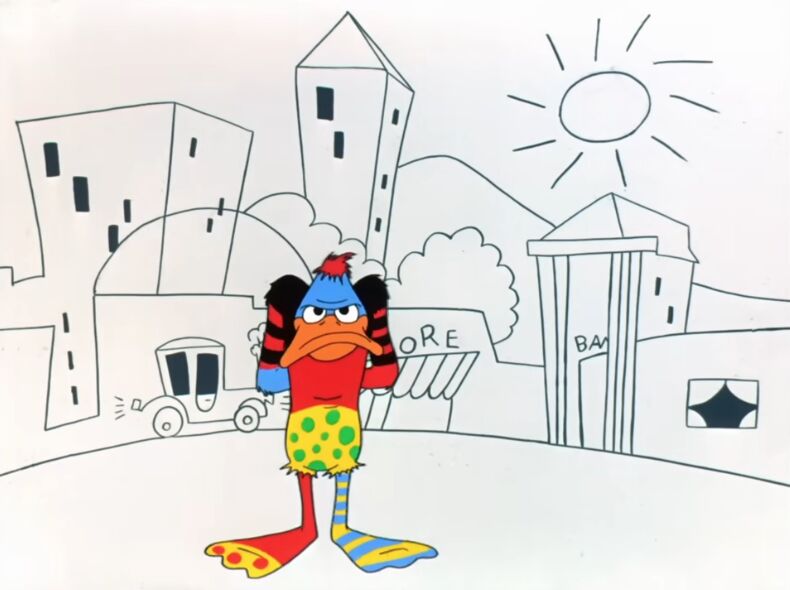
BTW, the grab is from Duck Amuck in 1953. It happens to perfectly capture the illusion of a winning ad as static truth. Daffy = ad, the canvas = context… OK, you get it.